What is needed for national implementation?
Engaging in carbon markets under Article 6 of the Paris Agreement requires the establishment of robust frameworks and processes, including procedures for authorisation, activity registration, accounting of mitigation outcomes, and reporting. Countries can leverage existing structures, refining them to better align with national priorities and circumstances, while ensuring full adherence to the Article 6 requirements.
Download this Excel-based checklist to guide you through Article 6 implementation, supported by evaluation questions for each step: Article 6 implementation checklist
What is the legal and policy foundation for carbon markets?
Engaging in carbon markets does not automatically require participation under Article 6 of the Paris Agreement. However, if a country intends to authorise internationally transferred mitigation outcomes (ITMOs), apply corresponding adjustments, and/or participate in the Article 6.4 mechanism, it must establish clear legal mandates and institutional procedures to do so.
More broadly, many countries are now developing national carbon market frameworks, whether or not they immediately engage under Art. 6. These frameworks typically regulate – among other things – project approval and registration, authorisation, registry systems, applicable fees and/or levies, and reporting in line with international rules.
To participate under Art. 6.2, governments must define how activities are approved, how mitigation outcomes are authorised for transfer and use towards another country’s Nationally Determined Contribution (NDC) or other international mitigation purposes (OIMP), and how corresponding adjustments are applied and reported. All these functions are anchored in clear legal foundations and mandates to provide legal certainty to market participants.
Download Information Note on Mandate and Legal FoundationThese case studies illustrate how countries are establishing legal foundations for carbon markets, including partiicpation under Article 6 of the Paris Agreement. They provide different country approaches (e.g., top-down legislative reforms, bottom-up administrative frameworks) shape national legal systems and institutional contexts. Together, they provide practical examples of how countries are anchoring carbon market governance in domestic law to ensure legal certainty and operational readiness.
Download Case StudiesThis section provides guidance on how countries can establish a legally grounded national governance structure for carbon markets. It outlines key institutional functions, formalised and anchored in domestic law to provide clear internal mandates. Drawing on international examples, it highlights different legal instruments and governance models used by countries to structure roles, responsibilities and operational procedures.
Download guidance note on national governanceThis section provides an overview of cooperative approaches under Article 6.2 of the Paris Agreement. It explains how countries structure unilateral, bilateral and plurilateral cooperation of the transfer of mitigation outcomes, outlines key deisgn elements of cooperation agreements, and clarifies reporting obligations (e.g., the Initial Report).
Download guidance note on cooperative approachesTracker: Carbon Market Regulations Tracker (Gold Standard 2025)
Blueprint: legal blueprint for developing and regulating carbon markets: guidance for law and policymakers (ADB 2025)
Repository: Scaling Cooperation: Bilateral Agreements and Article 6.4 Mechanism (A6IP 2026)
Report: Developing an Article 6 host party strategy (GGGI 2023)
How to determine national governance structures and institutional arrangements?
For a government to effectively implement Article 6, it remains essential to establish the appropriate governance structures and institutional arrangements. This involves defining roles and responsibilities for key actors, such as national focal points, to carry out their tasks and obligations under Article 6.
The designation of a Designated National Authority (DNA) is a mandatory requirement for Article 6.4, emphasising the integral role this entity plays in facilitating international cooperation. While not mandatory for Article 6.2, appointing an Article 6 focal point is highly recommended and serves as an important initial step in many countries. Although the DNA and Article 6 focal point can be separate entities, their roles often complement each other, enhancing coordination efforts. In countries with ample capacities, the focal point may be a well-established institution, such as a dedicated Carbon Market Office. Conversely, in other nations, a focal point might be an individual supported by an alternate, showcasing the adaptability of this approach to various national contexts. Most West African nations, along with over half of UNFCCC member countries, have already appointed DNAs.
Image source: Perspectives, based on Ghana Carbon Market Framework (2022)
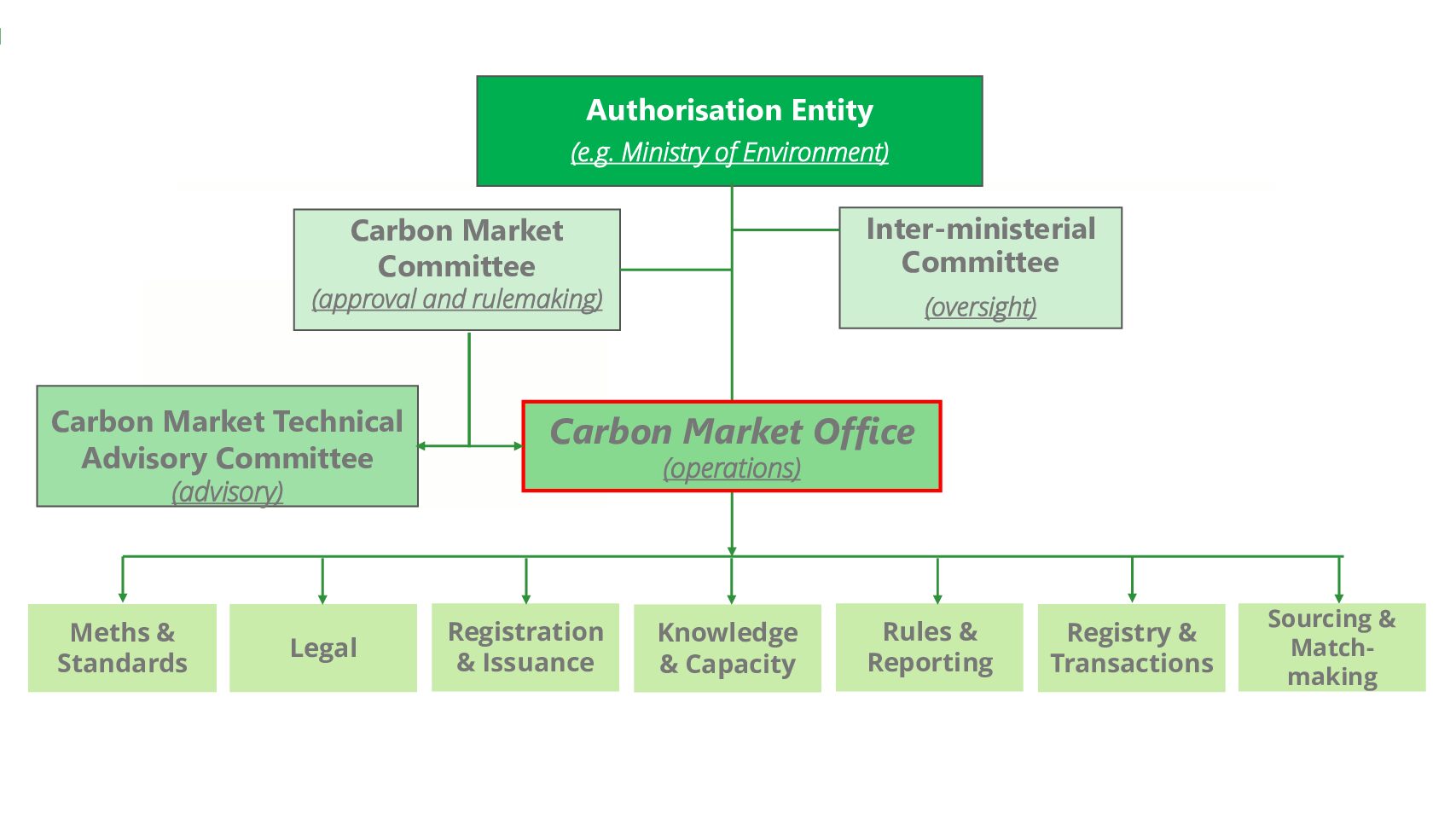
Ghana is one of the frontrunners of Article 6 institutional development. Early on, Ghana established a Carbon Market Office, which serves as the secretariat providing administrative and technical services to the public and supporting the implementation of the Ghana framework for international carbon market and non-market approaches. [only available in English]
Click to Access Ghana Carbon Market OfficeNigeria officially launched its National Carbon Market Framework in January 2026, with the aim of establishing a regulated system to generate, trade, and monetise carbon credits. The framework is overseen by the National Council on Climate Change (NCCC), the lead authority mandated to ensure the development of a robust and credible carbon market in Nigeria. [only available in English]
Click to Access Nigeria's Carbon Market FrameworkGuide: Developing an Article 6 host party institutional framework (GGGI 2023)
Brief: Implementing Article 6 of the Paris Agreement: Options for governance frameworks for host countries (GGGI 2023)
Manual: Article 6.4: Manual for host party participation in the Paris Agreement Crediting Mechanism (PACM) UNFCCC (2025)
Guide: Guidance on Governance Models for Host Country Engagement in Article 6 (GGGI 2022)
List: Article 6.4: Designated National Authorities (DNAs) for the PACM (UNFCCC 2026)
How to define operational procedures for ITMO accounting and reporting?
To effectively participate in Article 6, a country must establish clear operational procedures covering key aspects—such as authorisation processes, and the tracking and reporting of ITMOs—in order to comply with mandatory participation requirements. Beyond these core functions, additional operational procedures are important to provide clarity for project developers and to foster a robust pipeline of mitigation activities. This may include adopting or specifying relevant methodologies, standards, and guidelines for cooperation under Article 6, as well as implementing safeguards to uphold environmental and social integrity throughout the process.
This section sheds light on some procedures and requirements, with a particular focus on activities generating ITMOs under Article 6.2.
Image source: Perspectives Climate Group (2024)
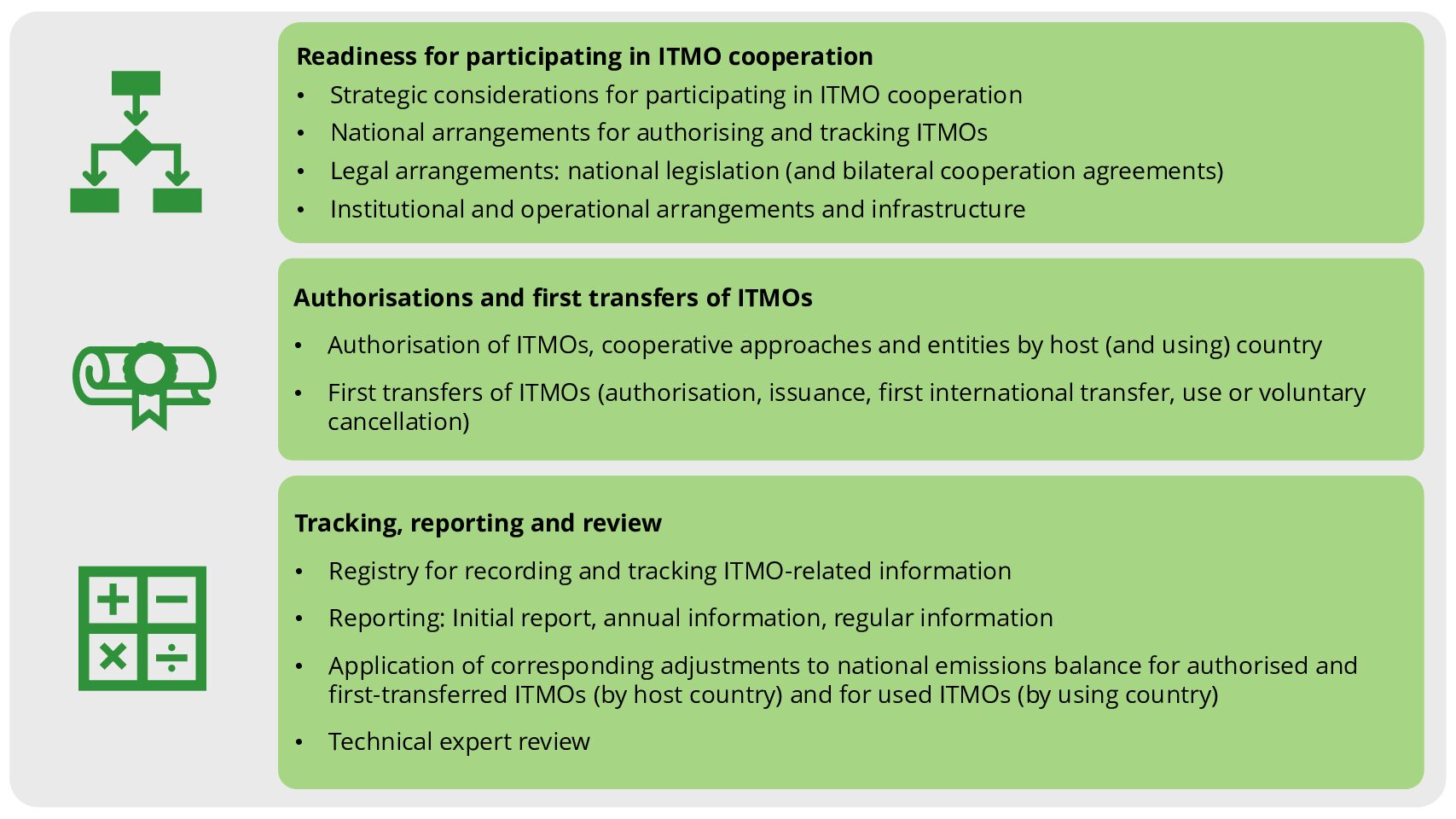
The national priorities and requirements pertaining to Article 6 are pivotal in shaping the decisions made by the host country regarding the establishment of specific conditions for the adoption of methodologies, standards, and guidelines governing Article 6 cooperation.
Download Information Note on Approving MethodologiesBy providing authorisation for particular activities, host countries can uphold environmental integrity. This informational note seeks to outline the fundamental requirements and factors to consider for Article 6 authorisation procedures to achieve this objective effectively.
Download Information Note on Authorisation and Authorisation SafeguardsA corresponding adjustment is the process of accounting for carbon market actions against the national mitigation commitments. This is to ensure that an emission reduction is not counted as a mitigation by two different entities towards their Paris pledges. Below you find a 5-step guide on how to apply corresponding adjustments.
Download Guide to Applying Corresponding AdjustmentsThe letter of authorisation represents the final authorisation for the mitigation outcomes of an activity. The authorisation of mitigation outcomes transfers these mitigation outcomes into ITMOs, as long as the contract for the Mitigation Activity continues to be fulfilled.
The UNFCCC released a voluntary standardised template for the authorisation of internationally transferred mitigation outcomes (ITMOs) under Article 6.2. You can download this document by clicking on the button below.
Download the UNFCCC template for ITMO AuthorisationTo uphold the Article 6 principles of environmental integrity and transparency, it is essential for Parties to report critical information on their Article 6 approaches clearly, accurately, and in a timely manner, including in their upcoming Biennial Transparency Reports (BTRs).
Download Information Note on ReportingGuidance: Guidance for stakeholders on applying COP29 Article 6 decisions (PCG 2025)
Host country authorisation
- Guidance: Key issues regarding Article 6 authorisation (PCG 2024)
- World Bank Template: Letter of Authorization and Acknowledgement for authorizations under Articles 6.2 and 6.4 of the Paris Agreement (WB 2025)
- Report: : Supporting authorizations under Article 6 of the Paris Agreement: Lessons learned and key considerations (PCG 2023)
Corresponding adjustments
Case Studies
- Best practices case studies: Article 6 Governance Frameworks in Action: A collection of case studies from 6 host countries (GGGI 2025)
- Report: Implementing Article 6 an overview of preparations in selected countries (Gold Standard 2023)
- Summary report: Designing Governance Structures and Transactional Documentation for Mitigation Outcome Transactions under Article 6 of the Paris Agreement GGGI (2021)
Reporting according to the Enhanced Transparency Framework under the Paris Agreement
- Manual: Article 6.2: Reference manual for the accounting, reporting and review of cooperative approaches (UNFCCC 2025)
- Handbook : Technical handbook for developing country Parties on Preparing for implementation of the enhanced transparency framework under the Paris Agreement (UNFCCC 2023)
Submitting reports through the Centralized Accounting and Reporting Platform (CARP)
- National focal points of participating Parties are required to submit reports through the UNFCCC submission portal.
- For more information on information sensitivity, classification, and handling procedures for data designated as confidential by participating Parties under Article 6, paragraph 2 of the Paris Agreement, please refer to the Article 6 Code of Practice.
How to develop the right Article 6 infrastructure?
Parties interested in participating in Article 6 activities need robust systems to track and account for the authorisation, transfer, and use of ITMOs under Article 6.2. They must also record Article 6.4 emission reductions (A6.4ERs) generated under the Paris Agreement Crediting Mechanism (PACM), whether or not these are authorised for international transfer and use. This tracking is done through dedicated carbon credit registries. Under Article 6, the registry infrastructure consists of:
- Party registries and/or an international registry for recording ITMOs under Article 6.2 (including authorisations, transfers, acquisitions, cancellations, and corresponding adjustments); and
- The Article 6.4 Mechanism registry for issuing and tracking A6.4ERs generated under the PACM.
These registries interface with the UNFCCC’s central Article 6 database and reporting systems to ensure transparency, avoid double counting, and maintain environmental integrity.
Image source: Perspectives Climate Group
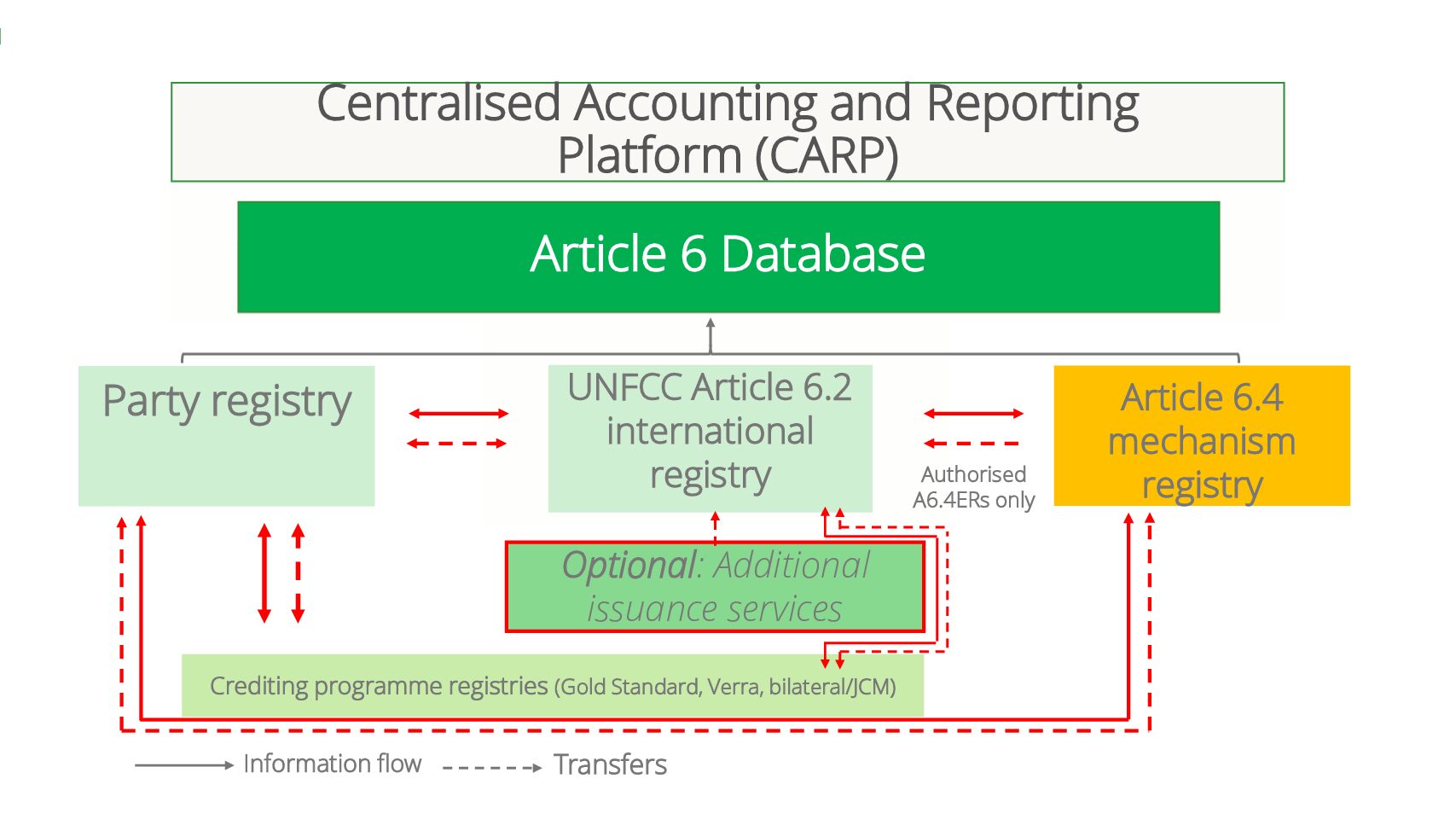
Parties engaged in cooperative approaches under Article 6.2 are required to consistently keep track of ITMO units or ITMO blocks. The information note contains more information on how this can be done.
Download Information Note on Article 6.2 RegistriesThis information note explains the Article 6.4 Mechanism Registry and the current status to record the emission reductions and removals (called A6.4ERs) generated by activities approved under the Paris Agreement Crediting Mechanism (PACM).
Download Information Note on Mechanism RegistryThe checklist presents factors that can assist Parties deciding whether to use the international registry offered by the UNFCCC or establish and maintain their own national registry for tracking ITMOs under Article 6.2, considering the Baku decision on Article 6.
Download the Checklist on Factors Influencing Registry Choice under Article 6.2Guide: User guide for the interim mechanism registry (UNFCCC 2025)
Report: Registry requirements for article 6 transactions – options for host country governments (CF 2024)
Discussion Paper: Interlinkages of registries and implications for functions and structures in the context of Article 6 (PCG 2023)
Guide: Transparency for cooperative approaches under the Paris Agreement: A guide to navigating the links between Articles 6 and 13 (ICAT 2023)
Report: Infrastructure to meet reporting requirements under Article 6 (WB 2022)
Paper: Understanding reporting and review under Articles 6 and 13 of the Paris Agreement (OECD 2021)
Which key aspects should be considered when designing fee structures and benefit-sharing arrangements?
Numerous steps are involved in the process of generating mitigation outcomes and allocating revenue to diverse groups, including activity developers, governments and other (local) stakeholders. The host country government holds the potential to influence or stipulate provisions for many of these stages, with decisions contingent on the strategic objectives for engaging in Article 6. This section explores considerations related to price generation for ITMOs, the sharing of benefits between host and buyer countries, the sharing of benefits on the national and sub-national level, as well as the fee structure designed to cover administrative fees and opportunity costs.
Image source: Climate Finance Innovators (2024)
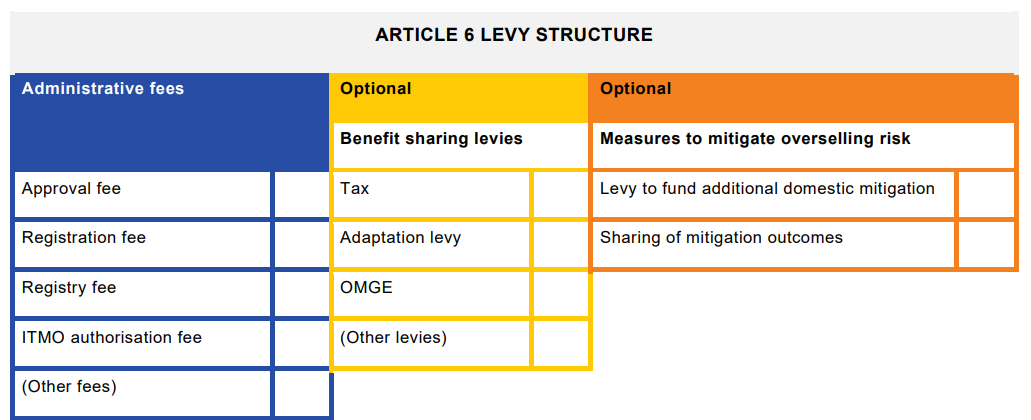
ITMO prices are typically documented in the MOPA and not publicly disclosed. The MOPA is negotiated between the entities overseeing an ITMO transaction.
Download Information Note on ITMO Price GenerationTo cover the costs of establishing and maintaining Article 6 Infrastructure a host country can impose levies or fees.
Download Information Note on Imposing Fees and LeviesThe equitable distribution of revenues from carbon market activities is gaining increasing traction in broader discussions around benefit-sharing within the carbon market realm.
Download Information Note on Sharing of Benefits between Host Country and BuyerThe Carbon Market Levies Simulator is a practical tool developed to support governments in designing and assessing fees and levies in their carbon market frameworks. It allows policymakers to test different fee levels and policy options and understsand their financial implications.
The Tutorial to the Levies Simulator is available on the West African Alliance’s YouTube page, via this link, here.
Download the tool via this link (Enable Macros)Guide: Setting an article 6 levy structure in Senegal: A practical guide to administrative fees and benefit sharing levies under Article 6 of the Paris Agreement (Climate Finance Innovators 2024)
Report: Host country strategies for identifying and managing overselling risks under Article 6 (Carbon Limits 2023)
Policy Paper: Sharing mitigation outcomes: How should climate benefits under Article 6 be distributed? (Wuppertal Institute 2023)
How to engage in the Paris Agreement Crediting Mechanism (PACM)?
Article 6.4 of the Paris Agreement establishes the Paris Agreement Crediting Mechanism (PACM). It works as a UNFCCC-supervised crediting programme that issues carbon credits for projects or activities that cut emissions or remove carbon from the atmosphere. These credits, called Article 6.4 Emission Reductions (A6.4ERs), may be traded internationally if they are authorised by host country governments.
Image source: UNFCCC
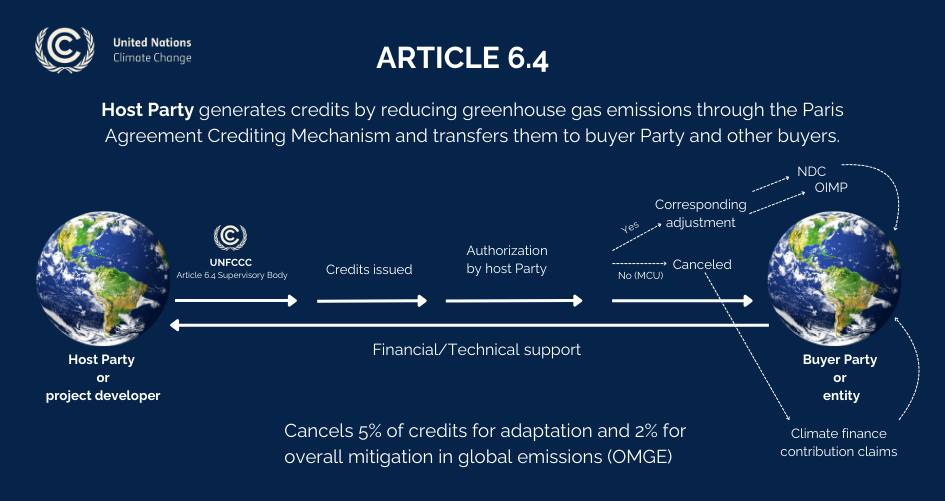
The PACM is now operational. The main remaining elements relate to operationalisation at the host country level, the development of methodologies and methodological tools, and the completion of the full registry system. Focal points are invited to consult this information note, as appropriate, to distinguish the key components of a fully operationalised PACM and understand their current status based on the official Article 6.4 documentation provided.
Download Information Note on PACM operationalisationThe host party’s engagement is crucial to the successful transition of a CDM activities. Host party obligations typically include facilitating the transition process, ensuring transparency, and adhering to international guidelines and rules. The deadline for host Parties to submit approval for the transition of CDM activities to the PACM has been extended from 31 December 2025 to 30 June 2026. This extension provides an opportunity for host countries to fast-track the assessment of CDM activities submitted for transition that have not yet been approved. This information note and checklist are intended to support this process.
Download Information Note CDM Transition to PACMFor more information on the CDM transition of activities, you can access the official webpage of the Paris Agreement Crediting Mechanism directed by the Supervisory Body.
Visit the CDM Transition page of the Supervisory BodyGuide: Authorizing Article 6.4 Carbon Credits (Perspectives Climate Research 2025)
Paper: The Paris Agreement Crediting Mechanism after COP29 (Climate Focus & Perspectives 2025)
Transition of CDM activities to the PACM
- Explainer: Practical Guidance on transitioning eligible CDM activities to Article 6.4 (UNFCCC 2025)
- Webpage: Transition of CDM activities (UNFCCC)
- Brief: Guidance on the transition of cdm projects to article 6.4 activities (GGGI 2024)
- Report: Adapting CDM methodologies for use under Article 6 of the Paris Agreement (PCG 2024)
- Report : Lessons Learned from the Kyoto Mechanisms for the Article 6.4 Mechanism (PCG 2024)
What is the role of voluntary carbon market activities under Article 6?
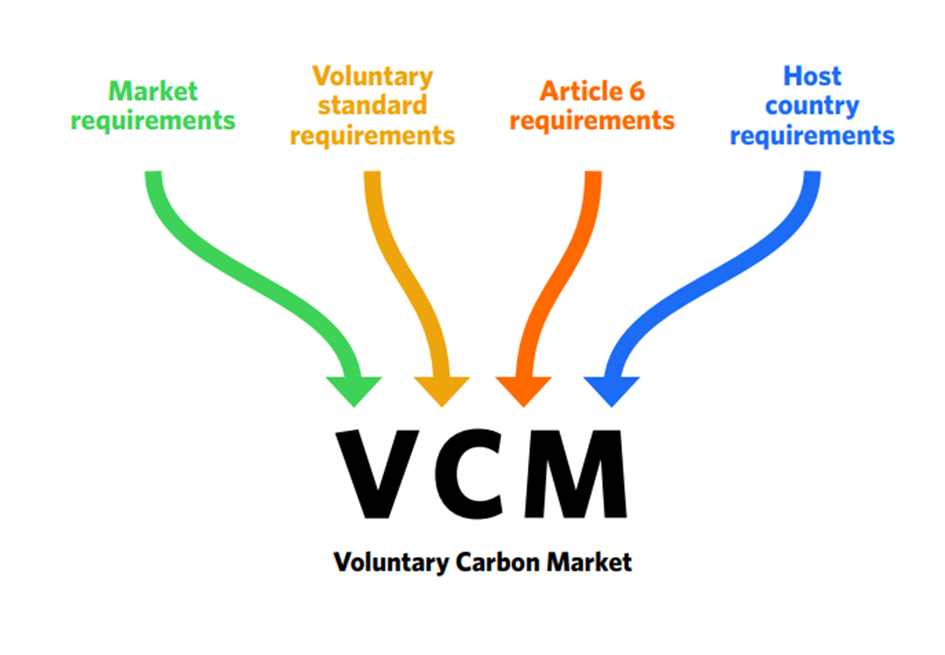
Voluntary carbon market (VCM) activities can be authorised by Parties under Article 6, with decisions shaped by national strategic considerations. If a country opts to integrate VCM activities into its national carbon market framework (or equivalent system), the rules and requirements of Article 6 must apply, just as they do for any other authorised activities.
Click below to learn more about this market segment and how to approach and manage it effectively.
Explore our VCM Knowledge Hub page