
How to engage strategically?
Engaging in Article 6 requires strategic decisions about how to incorporate carbon markets into national climate governance structures and policies, how to comply with international reporting requirements and how to define what goals a country wants to achieve by using Article 6. Consequently, understanding the national starting point is an important first step when engaging in Article 6. Successful implementation of Article 6 depends on close collaboration with project developers, international partners, including buyers and providers of technical assistance, as well as other relevant stakeholders to establish a strong pipeline of activities in the country.
What is the national starting point?
Understanding the current climate policy landscape and instiutional structures is the foundation for informed decision-making to ensure that Article 6 activities are aligned with the national context, needs and priorities. The regulatory landscape, administrative capacities, and available resources need to be assessed to tailor the approach to Article 6 to the country circumstances. A clear grasp of the mitigation target(s) of the NDC, as well as monitoring and reporting processes in the country is particularly important, as these are cross-cutting aspects for Article 6 operationalisation.

Countries should identify capacity gaps and leverage existing initiatives within the ongoing Article 6 capacity‑building landscape to address their technical needs. This checklist provides a tool to assess a country’s current capacities and pinpoint the key areas where further readiness is required for effective Article 6 implementation.
Download Checking for Mapping CapacitiesHaving an overview of past and ongoing carbon market activities will prove highly relevant for effective implementation of Article 6. This template helps document and track activities within a country’s borders, particularly those aimed at generating Internationally Transferred Mitigation Outcomes (ITMOs).
Download Template for Activity MappingFor government stakeholders, understanding the stages of Article 6 activities is essential for gaining deeper insights into a country’s mitigation efforts through collaborative approaches and for effectively engaging interested parties. This information note also provides a general overview of the key steps in the process and highlights important considerations for A6.2 and PACM activities.
Download Note on Stages of A6 ActivitiesThe NDC Partnership, supported by Perspectives Climate Group, has developed an interactive tool to help countries identify existing capacities and determine support priorities. By clicking this link, you can access this key resource, which includes a readiness framework and examples showing how to complete the tool to maximise its usefulness.
Click to Access the Article 6 Readiness Toolkit
A critical first step for host Parties to demonstrate their intent to participate in the Article 6.4 mechanism (Paris Agreement Crediting Mechanism, PACM) is filling out the Host Party Participation Requirements Form.
You can download the form, available on the UNFCCC website, using the button below.
You can use this guide prepared by the UNFCCC Article 6 Capacity Building Unit.
Host Party Participation Requirements For Article 6.4 MechanismTo kick-start effective engagement with Article 6, several core principles should be placed at the forefront. This publication highlights three key principles that host countries need to understand, as well as the specific criteria that should be implemented to realise them.
-
Principle One: Paris-aligned use of mitigation outcomes
-
Principle Two: Generation of high-quality mitigation outcomes
-
Principle Three: Robust accounting and transparency in Article 6 engagement
Which strategic decisions are required to engage with Article 6?
This section provides materials on how to go about deciding upon crucial components that will shape a country’s Article 6 strategy, delineating the scope and specifying the type of engagement sought in cooperative approaches.
Image source: Perspectives, based on GIZ (2024)
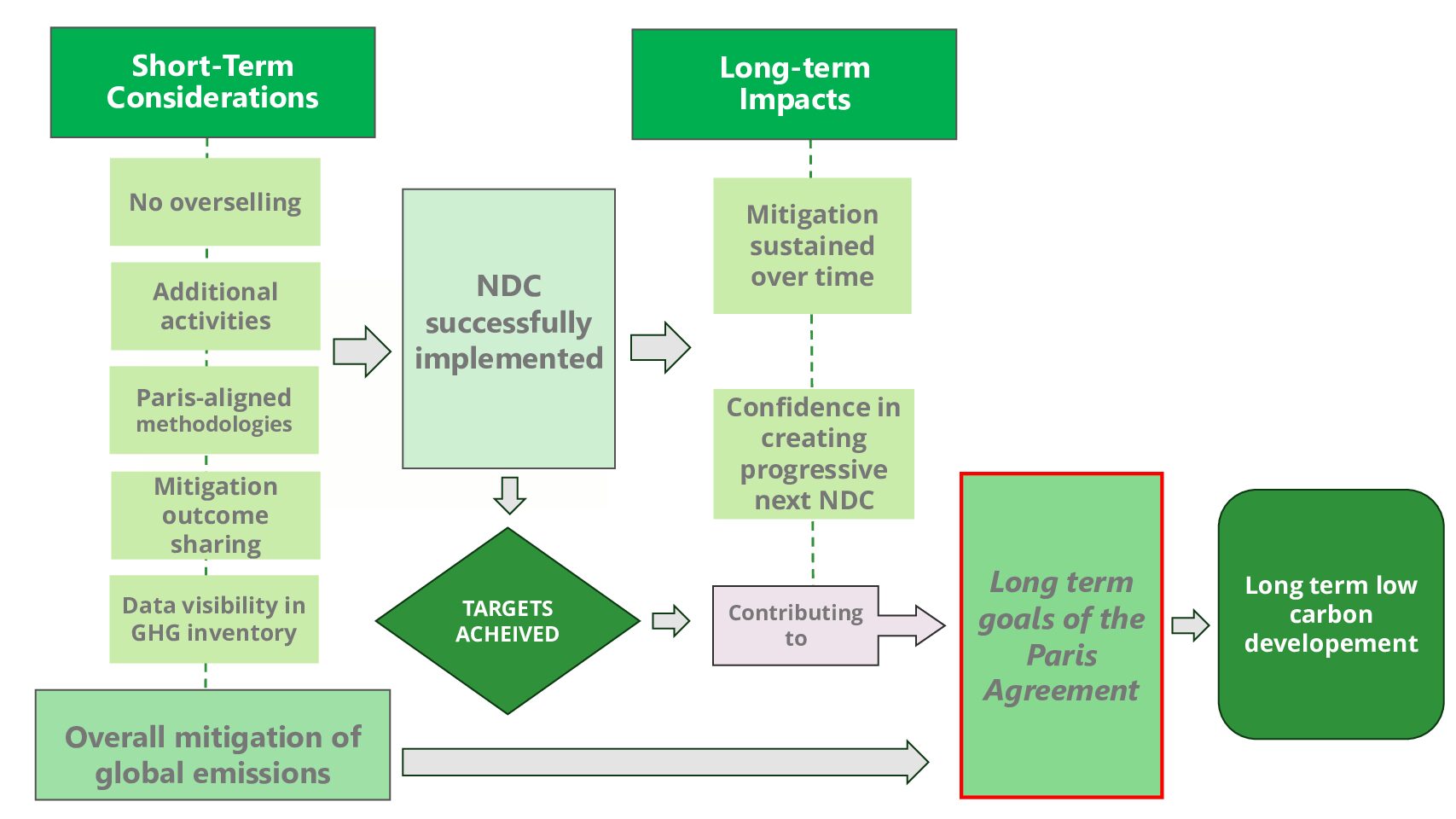
Strategic decisions on involvement in Article 6 can be influenced by diverse priorities and objectives. It is essential to periodically reassess these factors to ensure the strategy for Article 6 engagement remains up to date.
Download Information Note on Determining Strategic ObjectivesThe design of a country’s Article 6 strategy should be in line with its NDC and its respective NDC implementation plan (if available) to ensure coherence. Therefore, the country’s NDC should serve as a starting point when formulating the Article 6 strategy.
Download Information Note on Aligning A6 Strategy with the NDCAs sustainable development is a national prerogative, host countries need to provide guidance on how Article 6 activities align with and contribute to sustainable development. There are various approaches to address SD objectives, along with tools available for monitoring their impacts.
Download Information Note on Sustainable Development ObjectivesExplainer: Developing an Article 6 host party strategy (GGGI 2023)
Guidebook: Promoting ambition and transformational change using Article 6 (GGGI 2024)
Policy Recommendations: Scaling up NDC 3.0 Ambition through Article 6 (IETA 2025)
Report: Unlocking Africa’s Climate Ambition: Assessing NDC 3.0, NAPs, and LT-LEDS: A Review Report (CGIAR 2025)
Online Tool: IETA Article 6 and NDC tracker (IETA 2026)
PACM tool: Article 6.4 sustainable development tool (version 0.01) (UNFCCC 2024)
Explainer: On the adoption of the Sustainable Development Tool under Article 6.4 of the Paris Agreement (UNEP 2024)
How to engage with national and international stakeholders around Article 6?
Stakeholder participation is vital for the success of cooperative approaches and mandated under the PACM. Ensuring that local communities are included as well as entering into dialogues with project developers and private sector stakeholders fosters acceptance for carbon market engagement. Embracing global collaboration is paramount in the development of Article 6 activities. In addition, engaging with international partners plays a pivotal role as they can act both as ITMO buyers and providers of technical assistance and capacity building support.
Download List of Capacity Building Initiatives to Engage with International Partners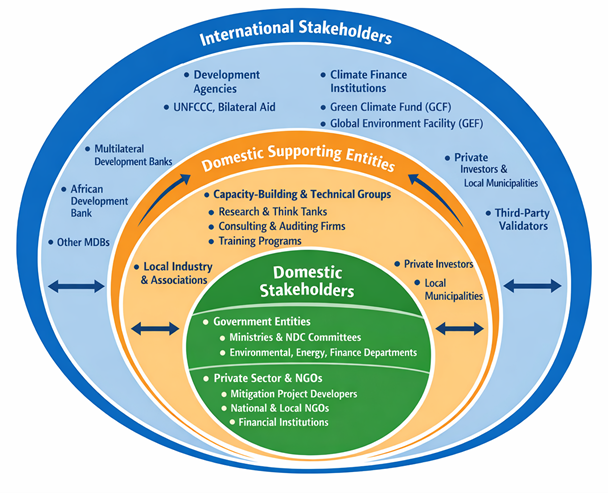
Guidance note: Private Sector Engagement in Article 6 (GIZ 2025)
Report: The Carbon Rights of Indigenous Peoples, Afro-descendant Peoples, and Local Communities in Tropical and Subtropical Lands and Forests (2025)
Guide: Stakeholder Participation Guide (ICAT 2020)