Welcome to the Knowledge Hub
The West African Alliance Knowledge Hub is designed to deepen understanding and promote strategic engagement with Article 6 and carbon markets, within the sub-region and globally. It offers a comprehensive overview of compliance and voluntary carbon markets, as well as climate finance, with a focus on topics that are particularly relevant to our Alliance member countries.
Our Knowledge Hub serves as a valuable resource for decision-makers in West Africa, though it is also informative for any stakeholders engaged in international carbon markets. It covers key topics related to Article 6, the Paris Agreement, the Voluntary Carbon Market, and Climate Finance. For each topic, users can download concise information notes that offer essential context, key considerations, and practical tools, including checklists, step-by-step guides, case studies, and templates. Additionally, each section features links to further resources for deeper exploration.
Further readings on carbon market implementation can also be found on the Article 6 Implementation Partnership Library, accessible here.
What is Article 6 of the Paris Agreement?
Article 6 of the Paris Agreement enables voluntary cooperation among countries to enhance the implementation and ambition of their Nationally Determined Contributions (NDCs), while also contributing to sustainable development. It establishes three distinct approaches: Article 6.2 and Article 6.4 (PACM), which are market-based mechanisms while the remaining one, Article 6.8, presents a non-market-based approach.
The rules for operationalising these approaches were initially adopted at COP26 in Glasgow (2021) and have continued to evolve through subsequent COP sessions. A major milestone was reached during the “Baku breakthrough” at COP29 (2024), when Article 6 became fully operational. These decisions were further reinforced at COP30 in Belém (2025). Together, these developments have brought significantly greater clarity to the Article 6 framework and will continue to guide and structure its implementation over time.
In the Article 6 Knowledge Hub page, you can learn more about strategic decisions involved when engaging in Article 6, gain insights into the essential institutional arrangements and operational procedures for effective implementation, and explore opportunities to assess and capitalise on the benefits of carbon market activities.
Explore our Article 6 Page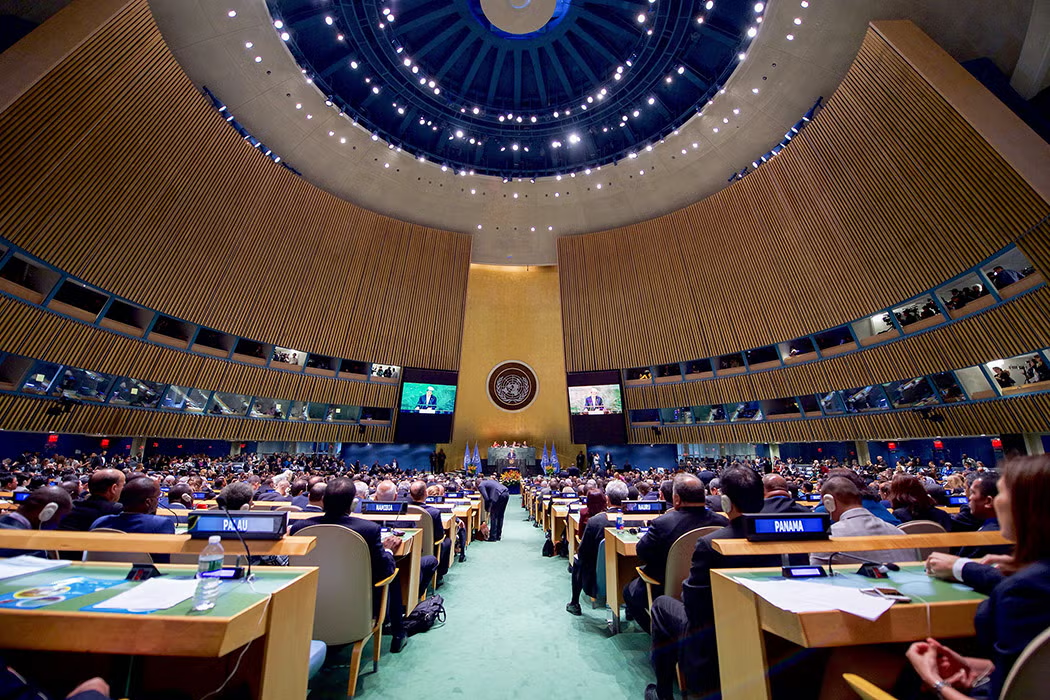
How to engage strategically?
Learn how to effectively engage with Article 6 by defining your national starting point, involving key stakeholders, and aligning with national priorities.
Find out moreWhat is needed for national implementation?
Learn how to successfully implement Article 6 by establishing legal frameworks, institutional arrangements, operational procedures, infrastructure, and more.
Find out moreHow to assess activities and cooperative approaches?
Learn how to evaluate Article 6 activity potential to effectively leverage cooperative approaches and deliver enhanced mitigation outcomes.
Find out moreWhat is the Voluntary Carbon Market?
The voluntary carbon market (VCM) enables companies, individuals, and organisations to support climate mitigation and sustainable development with the sale and purchase of carbon credits. Demand for carbon credits in the VCM is primarily driven by non-state actors who wish to contribute to climate action beyond mandatory carbon pricing mechanisms and make claims about their climate impact. Private carbon crediting programmes, such as Verra (formerly Verified Carbon Standard) and Gold Standard, issue carbon credits within the VCM.
Visit our VCM Knowledge Hub page to learn more about crediting programmes, types of credits, associated claims, best practices, integrity initiatives and how governments can regulate the VCM.
Explore our VCM page
How can climate finance accelerate climate action?
Countries have a range of climate policy instruments at their disposal to meet the mitigation and adaptation goals outlined in their NDCs. Implementing these policies requires substantial financial resources to address identified needs and carry out strategies tailored to achieve national targets. In its broadest sense, climate finance refers to funding from local, national, or transnational sources, including public, private, and alternative financing. It provides essential support for countries in advancing climate change mitigation and adaptation efforts.
Visit our Climate Finance Knowledge Hub page to learn more about available financial mechanisms, (sub)regional initiatives, and the integration of climate and carbon finance to support national emission reduction efforts and contribute to global climate goals.
Explore our Climate Finance page
How can carbon pricing instruments be relevant for carbon markets?
Carbon pricing—through taxes or cap-and-trade systems—assigns a cost to GHG emissions, driving reductions and encouraging low-carbon investment. While challenges such as limited institutional capacity, weak data systems, and equity concerns persist in West Africa, carbon pricing can play an important role in supporting sustainable development and clean technology adoption in the sub-region.
In Western Africa, carbon pricing is emerging, with nations like Senegal, Nigeria, and Guinea exploring or developing instruments like carbon taxes and Emissions Trading Systems (ETS) to fund climate action and attract green investment. While Guinea is set to launch West Africa’s first sector-specific carbon pricing, Nigeria is piloting a tax in its telecom sector, focusing on phased, context-specific approaches to drive low-carbon transitions and align with Paris Agreement goals.
Market mechanisms can strengthen carbon pricing by enabling efficient resource allocation and attracting private investment in renewable and low-carbon projects. In turn, carbon pricing helps countries engage in global carbon markets, mobilise climate finance, and align domestic actions with international mitigation goals.
Click below to know more about carbon pricing approaches available in West Africa.
Explore Carbon Pricing Approaches in West Africa