
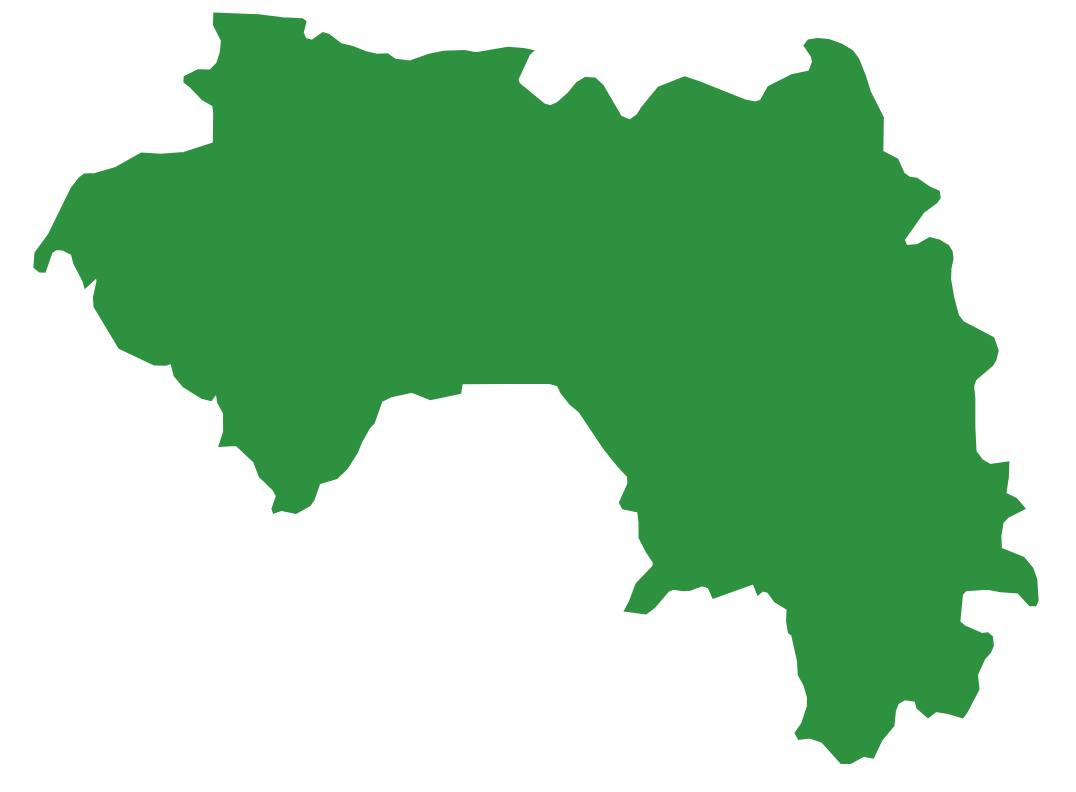
Guinée

Contribution déterminée au niveau national
Objectifs
Guinea’s NDC 3.0 sets an economy-wide GHG emissions reduction target for 2035 against a Business-as-Usual (BAU) scenario of 100,063 ktCO₂e.
At the economy-wide level, including AFOLU, Guinea aims to reduce GHG emissions by 17% unconditionally and by 49% conditionally by 2035, resulting in target emissions of 83,052 ktCO₂e and 51,032 ktCO₂e, respectively.
For the Energy, Waste and IPPU sectors (excluding AFOLU), the NDC sets an unconditional reduction target of 9.7% and a conditional target of 20% by 2035.
Article 6 engagement
The Republic of Guinea affirms its intention to participate in the international cooperation mechanisms provided for under Article 6 of the Paris Agreement. Priority sectors for carbon market development include forests, energy, agriculture and waste, reflecting the country’s identified areas of high carbon potential.
Guinea is progressively strengthening the institutional and regulatory framework required for its participation in carbon markets. The Ministry of Environment and Sustainable Development (MEDD) leads the national Article 6 framework, and a decree establishing a dedicated national carbon market/Article 6 unit has been adopted. Complementary strategic and regulatory instruments are under development to operationalise the framework, including procedures for the approval, monitoring and authorisation of carbon market activities and international transfers.
Guinea continues to explore market-based approaches under Articles 6.2 and 6.4, as well as non-market approaches under Article 6.8, to support its national climate objectives. The country also intends to mobilise carbon finance, including through Article 6 mechanisms and voluntary carbon markets, to support the implementation of its climate commitments.
Activités d'atténuation
The NDC 3.0 identifies seven key mitigation commitments:
L'énergie
- Prioritize the large-scale deployment of renewable energy for electricity generation.
- Modernize the wood-energy sector and shift heat production towards fully renewable solutions.
Forestry and Land Use
- Curb deforestation by generalizing sustainable forest management and expanding the network of protected areas.
Mining
- In line with the Simandou 2040 Programme, support the mining sector in moving towards a carbon-neutral (net-zero emissions) pathway.
Transport
- Improve the energy and logistical efficiency of the national transport system to reduce costs and emissions.
Déchets
- Generalize efficient urban waste collection and recovery through sorting, recycling, composting and energy recovery, in order to reduce emissions and pollution.
Agriculture
- Put the agricultural sector on a carbon-neutral pathway by 2050 through low-emission practices and increased sequestration in soils and agroforestry systems.
Secteurs couverts par la CDN
Energy, Industrial Processes and Product Use (IPPU), Waste, Agriculture, and Land Use, Land-Use Change and Forestry (LULUCF)
Besoins de financement
The overall cost of implementing Guinea’s NDC 3.0 is estimated at approximately USD 17.7 billion over the period 2026–2035, including USD 9.3 billion for mitigation and USD 8.4 billion for adaptation.
These figures will be refined during the preparation of the NDC 3.0 Investment and Operationalisation Plan in 2026.
Tarification du carbone
Statut
Non disponible
Marchés du carbone
Entités nationales responsables des marchés du carbone
Ministère chargé des marchés du carbone
Ministère de l'Environnement et du Développement Durable
Article 6.4 ADN
Mme Oumou Doumbouya
oumoudoumbouya1@gmail.com
CDM DNA
M. Abdel Kader Bangoura
ak_bangoura@yahoo.fr
Article 6 stratégie et règlements
Non disponible
Registre national
Prévu
Pipeline
Article 6
Accords bilatéraux
- Non disponible
Activités d'atténuation
- Non disponible
MDP
Données
Marché Volontaire du Carbone
Télécharger le portefeuille d'activités de VCMDonnées
Au 6 septembre 2024, la Guinée a 1 projet enregistré auprès du VCM, qui est enregistré sous le GS.
Au 6 septembre 2024, les projets domestiques sont la seule activité VCM en Guinée avec des crédits émis, représentant un total de 11,78 kt.
2019 a été l'année avec le plus grand volume de crédits émis pour les projets domestiques, avec 8,35 kt émis.
Au 6 septembre 2024, les projets domestiques sont la seule activité VCM en Guinée avec des crédits retirés, représentant un total de 11,77 kt.
2021 a été l'année avec le plus grand volume de crédits retirés pour les projets domestiques, avec 3,27 kt retirés.