From Marrakech to Antalya: ten years of building high-integrity carbon markets in Africa
Ten years after its creation in Marrakech, the West African Alliance on Carbon Markets and Climate Finance (WAA) brought together its member countries, its partners and its sister alliances from Eastern and Southern Africa at COP31 in Antalya. Co-organized with the Republic of Guinea and streamed live by UN Climate Change, the side event “Building High-Integrity Carbon Markets in Africa” took stock of a decade of capacity building. Above all, it raised the question that will guide the next ten years: how do we move from readiness to investment?
An alliance born of an African conviction
The Alliance was founded in Marrakech in 2016, at the initiative of national focal points and West African carbon market experts. Ten years on, it remains firmly rooted in the region’s institutions.
Its mission has not changed: to strengthen the role of West African countries in carbon markets and to help them mobilize finance for their Nationally Determined Contributions (NDCs). Today it brings together 16 member countries: Benin, Burkina Faso, Cabo Verde, Côte d’Ivoire, The Gambia, Ghana, Guinea, Guinea-Bissau, Liberia, Mali, Mauritania, Niger, Nigeria, Senegal, Sierra Leone and Togo.
Ten years in three phases
In a decade, the Alliance has moved from institution building to the concrete implementation of Article 6 of the Paris Agreement, which governs international carbon markets.
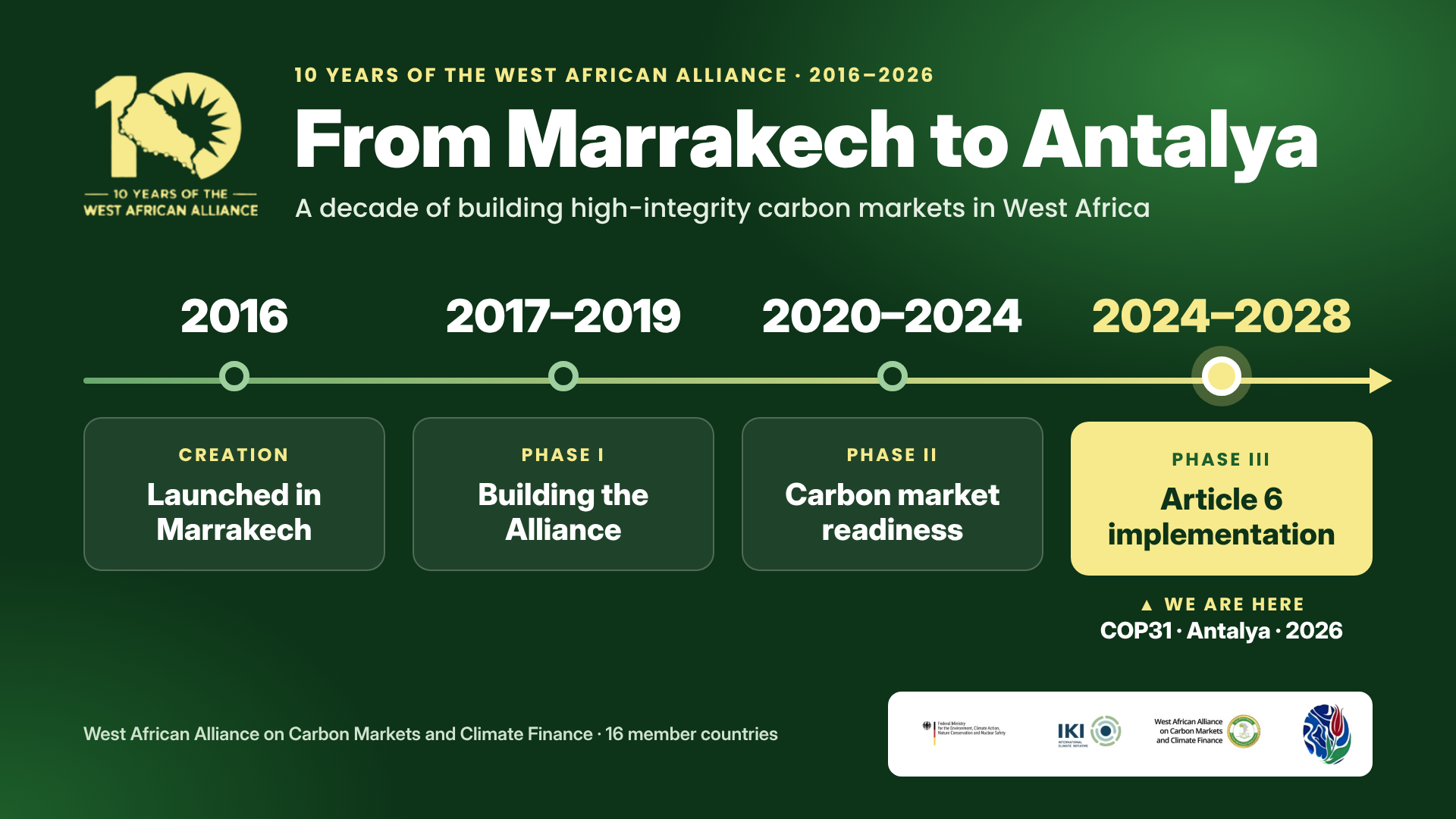
In Antalya, the Alliance celebrated its tenth anniversary in the middle of Phase III: the stage where readiness must translate into transactions and finance.
An opening built on partnership
The side event opened with welcome remarks from the Chair of the Alliance, held by Nigeria, and from the Republic of Guinea, co-organizer of the event. Germany’s Federal Ministry for the Environment (BMUKN) and the West African Development Bank (BOAD) then took the floor. This opening sequence was a reminder that the Alliance’s success rests on long-term political, technical and financial support.
The keynote “From Marrakech to Antalya – 10 years, 10 milestones” then retraced the road travelled and marked the launch of the Alliance’s anniversary booklet.
Country voices
Four national focal points shared their experience in four minutes each: Guinea, through its Ministry of Environment and Sustainable Development; Nigeria, with the Department of Climate Change of the Federal Ministry of Environment; Côte d’Ivoire, with the Technical Secretariat of its Carbon Market Office; and Tanzania, with its Division of Environment, on behalf of the Eastern Africa Alliance.
These talks showed the diversity of national pathways, and what the Alliance brings in practice: a space for peer exchange, shared expertise and support in building national frameworks.
Three alliances, 32 countries
Following in the footsteps of the WAA and its 16 member countries, two sister alliances have emerged: the Eastern Africa Alliance and the Southern Africa Alliance, with 8 countries each. Together, they bring together 32 African countries cooperating on carbon markets and climate finance.
Their presence in Antalya gave the side event a continental reach: Africa is no longer simply watching carbon markets, it is organizing itself to shape them.
Next stop: investment
The closing panel brought together the coordinators of the three alliances around one central question: “What can regional alliances do over the next decade to help countries move from readiness towards investable, high-integrity carbon market activities?”
After ten years devoted to capacity and institutional frameworks, the challenge now is to turn that readiness into concrete, credible and bankable projects. High integrity is the precondition: without it, there is neither buyer confidence nor lasting investment.
The Alliance enters this new stage with a rare asset: ten years of collective experience and a network of countries moving forward together.